Engineering & Design
Technical study · Engineering & Design
Gas Dispersion Modelling for Hazardous Area Classification
CFD modelling of credible leaks in a naturally ventilated compressor building, to replace a conservative 3 m zone with a defined hazardous volume and keep low-level equipment general purpose.
What the client needed
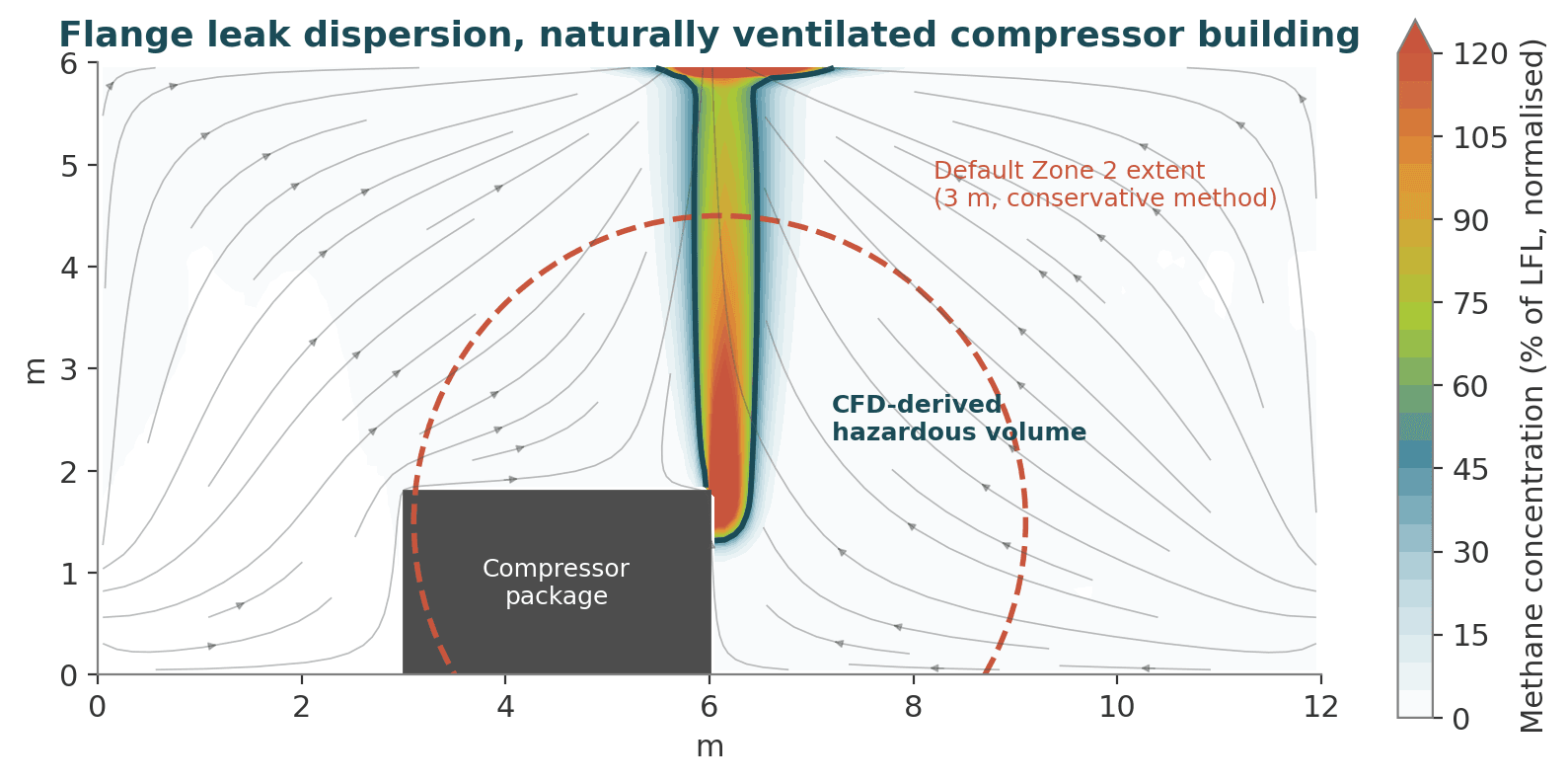
A biomethane producer was building a compressor station inside a naturally ventilated building. Applying the standard hazardous area method conservatively gave a 3 m Zone 2 around every flange and valve. That would have put the motor control equipment, lighting and instruments inside the hazardous area and needed Ex-rated equipment throughout.
The question they needed answered: Is the conservative zone realistic for this building, or can modelling justify a smaller, better-defined hazardous area?
- 3 mdefault zone replaced by a defined column
- ~$180kEx-rated equipment avoided
- CFDbasis documented for the hazardous area dossier
What we did
- Identified credible release sources and leak sizes in line with AS/NZS 60079.10.1.
- Built a CFD model in COMSOL of the building, its low-level louvres, ridge vent and compressor package, including the buoyancy of methane.
- Simulated releases at the key sources in low-wind conditions and mapped where concentration exceeds the threshold that defines the hazardous volume.
- Compared the modelled volume with the conservative default and documented the basis for the revised classification.
What we found
Methane rises quickly and leaves through the ridge vent. The hazardous volume is a narrow column above each release and a region at the roof vent.
Concentrations at the height of the motor control equipment and instruments stay well below the threshold, as long as the low-level louvres stay open.
Keeping low-level equipment general purpose avoids around $180,000 of Ex-rated equipment, plus Ex inspections for the life of the plant.
The trade-off is that the classification now depends on ventilation. The louvres and ridge vent become safety-critical, so gas detection at high level and louvre inspections go into the maintenance plan.
What we recommended
- Adopt the modelled hazardous area, documented with the CFD basis in the hazardous area dossier.
- Keep motor control equipment and general-purpose instruments at low level, outside the hazardous volume.
- Treat the louvres and ridge vent as safety-critical: never blocked, inspected regularly, with gas detection at high level.
Key assumptions
Release rate and hole size from AS/NZS 60079.10.1 guidance. Results apply to the modelled ventilation arrangement only; any change to openings needs review.
Talk to our engineers
Tell us what you're working on, and one of the people below will get back to you.
Talk directly to


Want to join us? We're always keen to hear from engineers who value strong fundamentals and real delivery experience.
Careers at Amarna