Technical Advisory & Assurance
Technical study · Technical Advisory & Assurance
How much public charging heavy electric trucks will need in South East Queensland by 2035, where it should go, what it means for the network, and why early hubs struggle to break even.
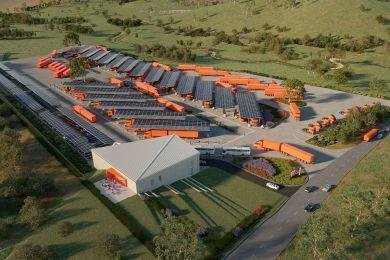
A state infrastructure agency and a private charging investor were planning public charging for heavy electric trucks across South East Queensland. They needed to know how much charging would be needed, where and when, and what it would mean for the electricity network.
The question they needed answered: How much heavy vehicle charging will the region need by 2030 and 2035, where should it go, and what grid capacity has to be in place?
About three quarters of the energy will be delivered at depots overnight. The public network is smaller but harder: it has to be in the right places, take B-doubles and connect to the grid at multi-megawatt scale.
The grid connection is the critical path. A 10 to 20 MW hub needs a dedicated connection, often at 33 kV or above, which can take two to four years.
Unmanaged depot charging could add up to 245 MW of evening demand by 2035. Smart charging and on-site batteries can roughly halve that.
At the 3 to 8% utilisation likely before 2030, a 4 MW hub loses up to $1 million a year, mostly from demand charges that apply whether trucks turn up or not.
A battery to cap grid demand lowers break-even to about 11%, but doesn't close the early gap alone. Anchor fleet contracts, a suitable demand tariff or targeted support during ramp-up do.
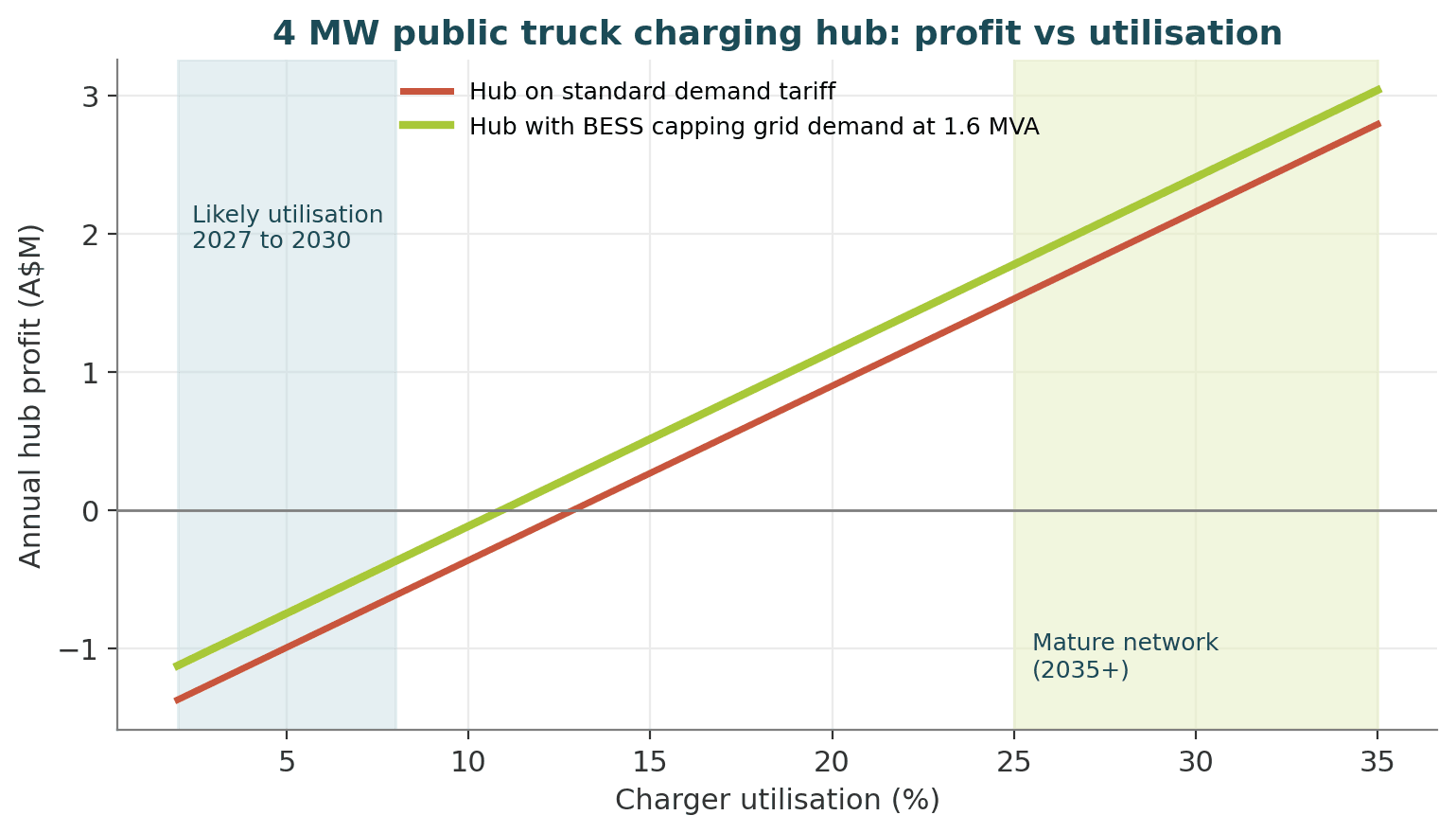
Regional fleet of about 13,000 articulated and 22,000 heavy rigid trucks (to be checked against ABS data). 2035 central electric share 15% articulated and 20% rigid. 25% of energy from public charging.
Technical Advisory & Assurance
Engineering & Design
Technical Advisory & Assurance
Engineering & Design
Project Delivery & Owner's Engineering
Tell us what you're working on, and one of the people below will get back to you.
Talk directly to


Want to join us? We're always keen to hear from engineers who value strong fundamentals and real delivery experience.
Careers at Amarna