Technical Advisory & Assurance
Technical study · Technical Advisory & Assurance
An independent check of a three-year-old 100 MW / 200 MWh battery for a prospective buyer: degradation, warranty compliance, availability and what they mean for the price.
An infrastructure investor was preparing a binding offer for a 100 MW / 200 MWh grid-connected battery, three years into operation. The seller's information memorandum said the asset was performing as expected.
The question they needed answered: Is the battery performing as the seller says, what will it cost to keep delivering its contracted capacity, and should any technical risks change the price or the deal terms?
The hardware is in reasonable condition and well maintained. The issue is how hard the battery has been worked.
Measured state of health after three years is 91.4% against a warranted 92.6%. On this trajectory the battery falls below its contracted 200 MWh in year 5, so the first augmentation is needed in year 5 rather than the seller's year 8.
The battery has averaged about 1.6 full cycles a day chasing arbitrage and FCAS revenue, against a warranty cap of 365 cycles a year. On a strict reading, part of the warranty is already at risk.
Availability (97.1% against 98% guaranteed) and round-trip efficiency (85.2% against 86%) are slightly short. Neither is serious alone, but both affect revenue.
Each MWh of throughput uses up around $40 to $60 of battery life. Bidding that cost in would cut cycling to about 1.1 a day for a modest revenue loss, by filtering out the low-value cycles first.
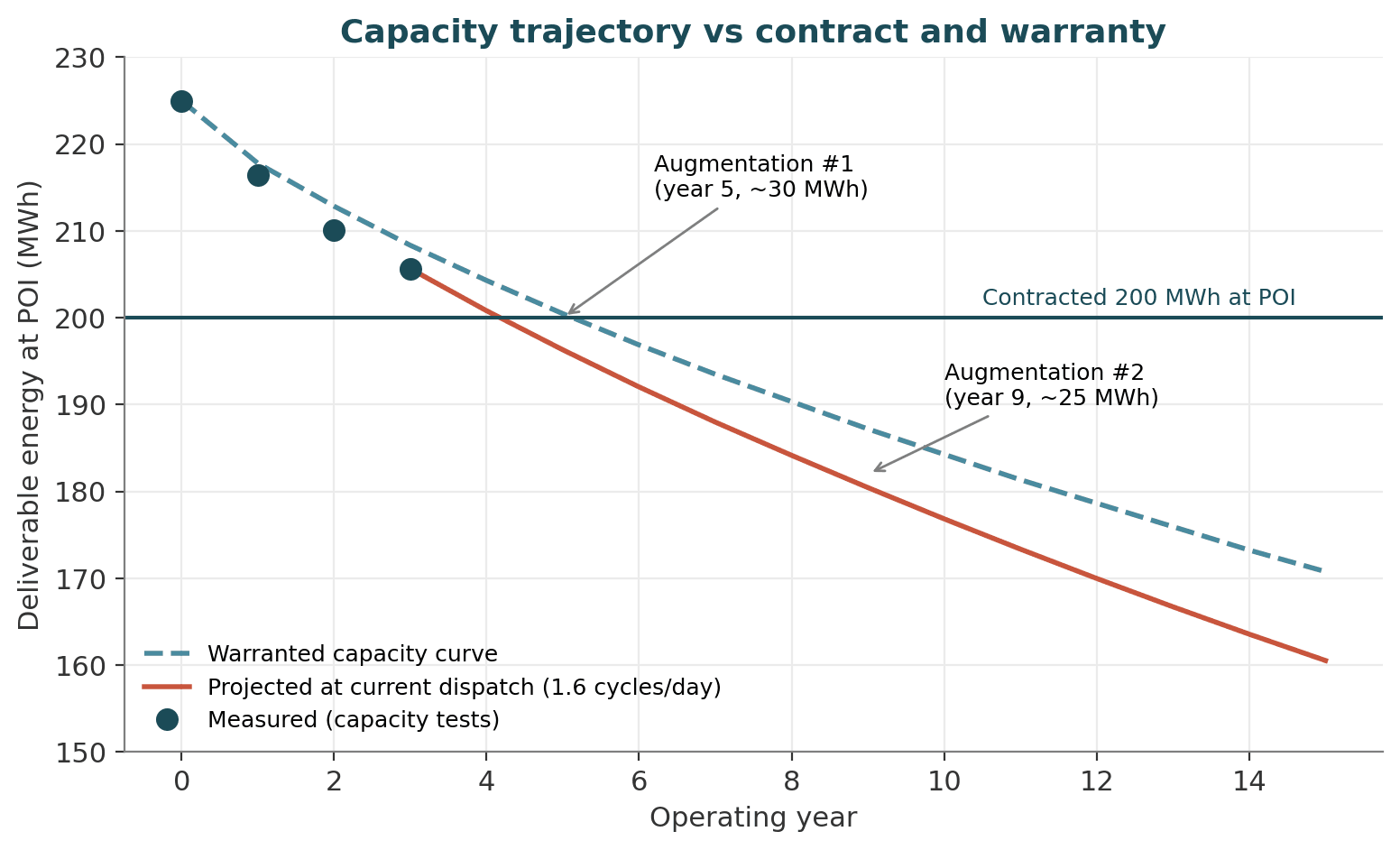
Deliverable energy taken as installed DC capacity × state of health × 0.9. Augmentation around $370/kWh installed.
Tell us what you're working on, and one of the people below will get back to you.
Talk directly to


Want to join us? We're always keen to hear from engineers who value strong fundamentals and real delivery experience.
Careers at Amarna