Technical Advisory & Assurance
Technical study · Technical Advisory & Assurance
How a 50 MW data centre campus can give tenants capacity three years before full grid supply arrives, with bridging power, battery-led backup and an hourly-matched renewable supply.
A developer was planning a 50 MW (IT load) data centre campus in South East Queensland, with tenants wanting capacity from 2028. The network could offer 10 MW straight away, 25 MW from 2029, and the full 70 MW only after a new substation in 2031.
The question they needed answered: How do we deliver capacity on the tenants' timeline when the grid can't, and how do we meet their renewable energy and backup requirements?
Grid capacity, not land or buildings, sets the timing. AEMO's 2026 forecasts have data centre consumption in the NEM rising from about 5 TWh to around 34 TWh by 2035-36.
Bridging power costs perhaps $100/MWh more than grid supply, around $7 to $8 million a year on 10 MW of average load. Against that, 10 MW of leased AI capacity can earn around $24 million a year.
The campus needs up to 17 MW of bridging power from 2028 to 2030. Leased modular gas engines plus a 10 MW / 20 MWh battery cover the gap, and the battery stays on for backup, power quality and grid services when the substation arrives.
Battery-led backup lets the diesel generators be sized for extended outages only, and they can run on renewable diesel.
A solar-only PPA matches about a third of campus load hour by hour. Adding wind lifts that to about two thirds, and adding storage to around 85%.
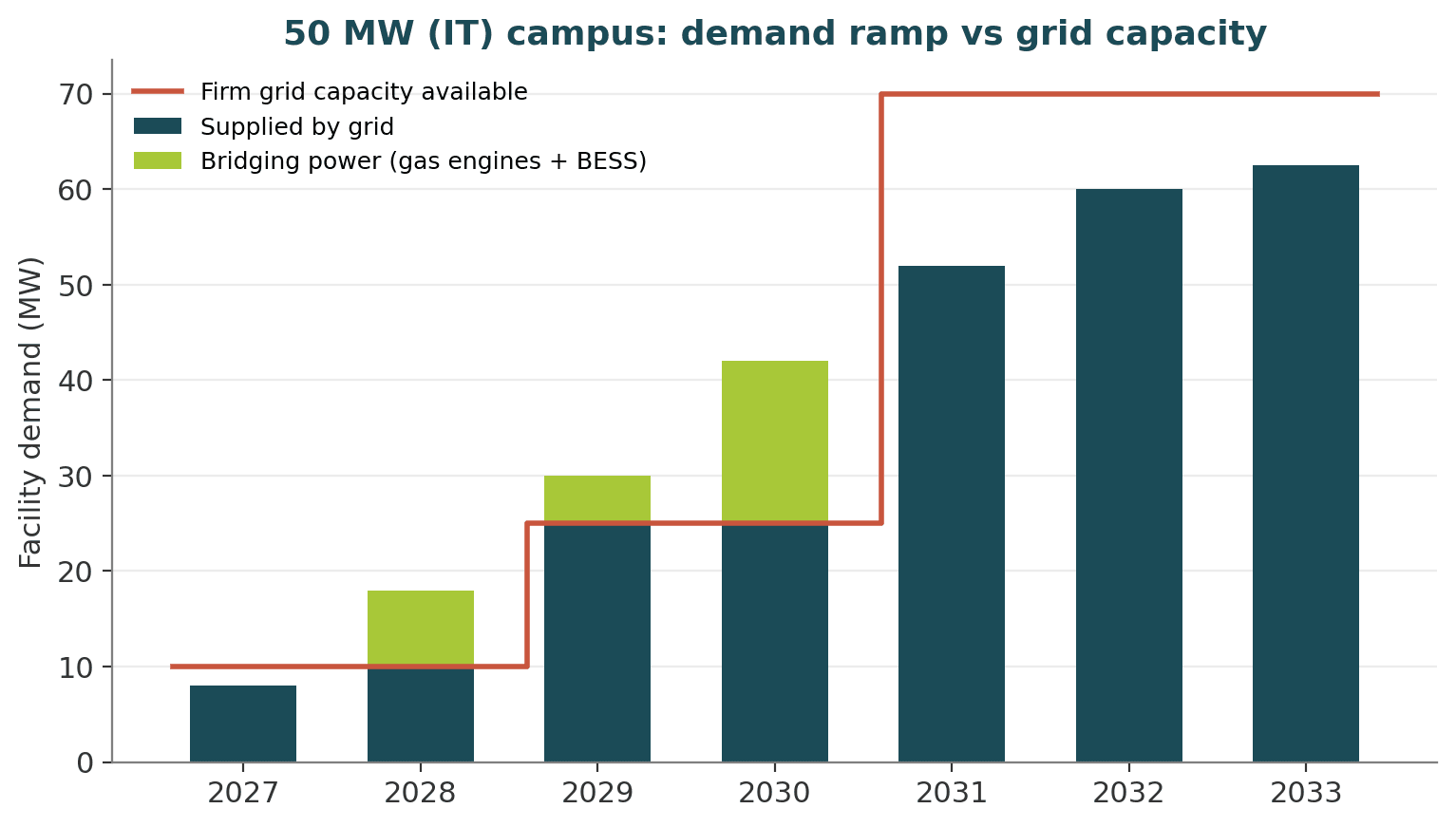
PUE 1.25. IT load ramp based on tenant pre-commitments. Grid capacity dates are indicative. Hourly matching based on typical Queensland solar and wind profiles. References: AEMO 2026 ESOO and ISP.
Tell us what you're working on, and one of the people below will get back to you.
Talk directly to


Want to join us? We're always keen to hear from engineers who value strong fundamentals and real delivery experience.
Careers at Amarna